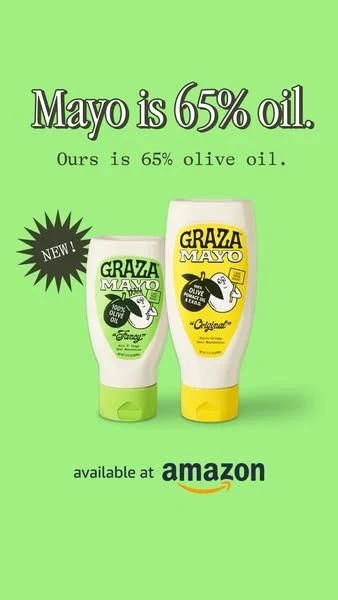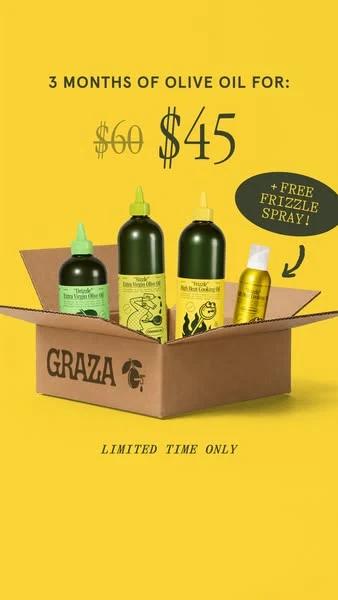
Why does the Graza ad work?
Time beats units. “Three bottles for $45” is a math problem. “Three months of olive oil” is a picture of your kitchen. The ad picks the picture.
The anchor is on the page. The $60 is struck through but still readable. The reader sees the old price first, so $45 lands as a saving.
The gift is a sticker, not a paragraph. A dark speech bubble says “+ free Frizzle spray!” with an arrow to the can. It adds value without adding reading time.
What copy is worth stealing?
Here is every line of text on the ad and around it, transcribed as it ran. Spelling and capitals are the brand’s.
- On-ad headline
- 3 months of olive oil for:
- On-ad price
- $60 (struck through) $45
- On-ad bubble
- + free Frizzle spray!
- On-ad footer
- Limited time only
- Primary text
- Now for a limited time, get 25% off three oils for all your cooking adventures! “Sizzle” Extra Virgin Cooking Oil for roasting & toasting. “Drizzle” Extra Virgin Finishing Oil for dipping & dressing. “Frizzle” High Heat Cooking Oil for grilling & frying.
- Link headline
- Limited Time Only
- Button
- Shop Now
What does the Graza bundle ad show?
The background is a warm, saturated yellow. At the top, small caps read 3 MONTHS OF OLIVE OIL FOR. Below, a struck-through $60 sits beside a much larger $45.
Three Graza bottles stand in an open cardboard box stamped with the Graza name. A spray can sits beside them, and a dark bubble with an arrow says “+ free Frizzle spray!” The footer reads Limited time only.
What is a price anchor in an ad?
A price anchor is the first number a shopper sees. Every later number gets judged against it. Here the anchor is $60, so $45 reads as a deal instead of a cost.
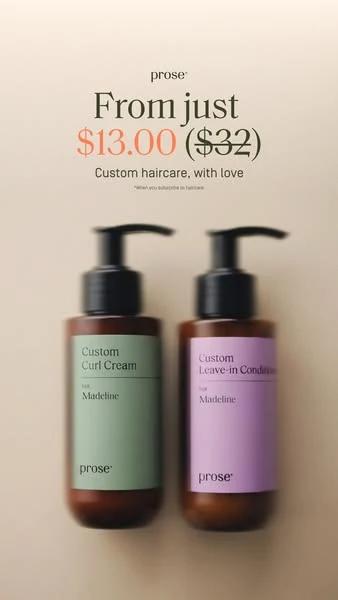
The struck-through style matters. It tells the reader the old price is real and that this one is temporary. We collect more of these in our price anchor ad examples, including Prose’s “From just $13.00 ($32)” card.
| Framing | What the reader thinks |
|---|---|
| 3 bottles for $45 | Is $15 a bottle good? |
| 25% off three oils | 25% off what? |
| 3 months of olive oil for $45 | That’s about $15 a month. Easy. |
Why is the primary text so different from the image?
The image speaks in months and dollars. The primary text speaks in percent off and product names: Sizzle, Drizzle and Frizzle, each with its own job.
That split is smart. The image grabs the scroller who reads nothing. The text serves the person who stops and wants to know what is in the box. Each layer has one job.
How would you use this hook?
- Turn your bundle into a span of time your buyer understands: a month, a season, a school term.
- Show the regular price struck through, then the offer price larger and bolder.
- Add one small free item as a sticker or bubble, not a sentence.
- Use the primary text to explain what is inside, product by product.
- Put a real end date on the offer and honor it.
Where does the click go?
The display link reads GRAZA.CO and the button says Shop Now, so this ad sends shoppers to the brand’s own site.
An offer ad sets a promise: $45, three oils, a free spray. The page after the click should show that exact bundle and price above the fold. Sending offer traffic to a homepage makes people hunt for the deal, and many won’t.
Teams that run several offers often build one landing page per ad. You can do that in Shopify’s theme editor, a page builder like Replo, or with a developer. The tool matters less than the match.
Frequently asked questions
How much is the Graza olive oil bundle in the ad?
The ad shows $45, with $60 struck through, for three oils plus a free Frizzle spray. Prices change, so check Graza’s site for the current offer.
Why say “3 months” instead of “3 bottles”?
Time is easier to value than a count of bottles. Shoppers split $45 across three months on their own, and a monthly figure feels small.
Is a struck-through price allowed in ads?
Generally yes, if the original price was genuinely charged. Many regions have rules on reference prices, so keep records of real past pricing.