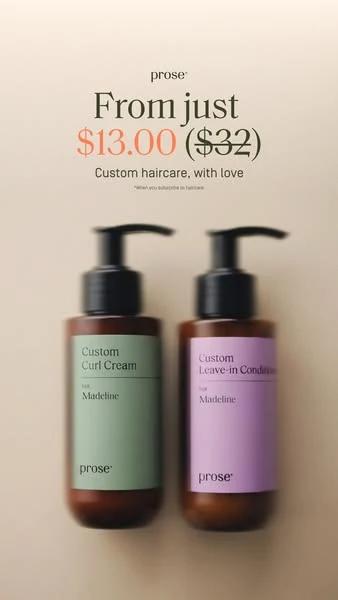
Why does the Prose ad work?
The price is the headline. Custom haircare sounds expensive. Leading with $13 answers the first objection before the reader can form it.
The anchor sits in brackets. The ($32) is struck through but kept close to $13. The reader sees both at once and reads the gap as a gift.
A name does the explaining. Each bottle says “for Madeline”. You understand the product is made for one person without a single line of copy.
What copy is worth stealing?
Here is every line of text on the ad and around it, transcribed as it ran. Spelling and capitals are the brand’s.
- On-ad headline
- From just $13.00 ($32)
- On-ad subline
- Custom haircare, with love
- On-ad fine print
- *When you subscribe to haircare.
- Bottle labels
- Custom Curl Cream · Custom Leave-in Conditioner · for Madeline
- Primary text
- Haircare hits different when it’s made just for you. Try it for yourself with 60% off your custom formulas.* Your hair will thank you.
- Link headline
- Don’t miss out on 60% off
- Button
- Shop Now
What does the Prose ad show?
The background is a soft beige with warm light from the top left. The small Prose wordmark sits at the top. Under it, the headline reads From just $13.00 ($32), with $13.00 in a coral tone and $32 struck through.
Two amber pump bottles stand below, slightly blurred at the edges. One is green-labeled Custom Curl Cream. The other is lavender-labeled Custom Leave-in Conditioner. Both carry the name Madeline.
Why lead with “from just” pricing?
“From just” tells the reader the lowest price they could pay. It is a price anchor that works in reverse: instead of making the deal look big, it makes the risk look small.
This suits any product that needs effort before purchase. Prose builds formulas from a consultation, and the ad’s other versions mention a quiz. A low first price makes the effort feel worth it.
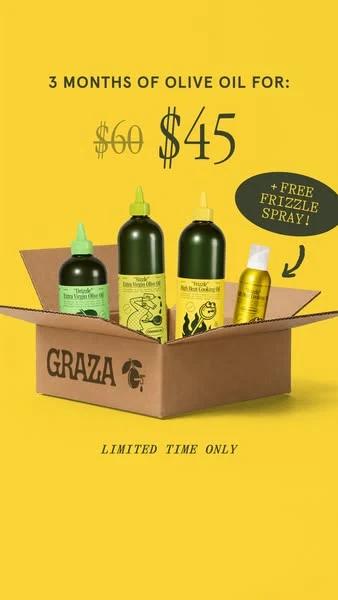
Compare it with Graza’s $60-to-$45 bundle. Graza anchors high to make $45 feel like a saving. Prose anchors low to make starting feel safe.
| Ad | Anchor | What it fixes |
|---|---|---|
| Graza bundle | $60 struck to $45 | “Is this a good deal?” |
| Prose | From $13 ($32) | “Is custom too expensive to try?” |
Why does the text say 60% off when the image says $13?
The image gives a dollar figure and the primary text gives a percentage. Both describe the same first-order discount from two angles.
Dollar figures feel concrete. Percentages feel big. Running both lets each reader latch onto the version that persuades them. The asterisks in both places point to the same subscription condition.
How would you use this hook?
- Find the lowest honest price a new customer can pay, and its normal price.
- Write the headline as “From just $X ($Y)”, with $Y struck through.
- Show personalization in the image itself: a name, a label, a choice.
- Footnote the condition (subscription, first order) on the image and in the text.
- Keep the background calm so the price is the brightest thing on screen.
Where does the click go?
The button says Shop Now and the link headline reads Don’t miss out on 60% off. Other Prose ads in the library list PROSE.COM as the display link.
When a custom product starts with a quiz, the landing page has one job: carry the price promise into the quiz. Restate “From $13” at the top, then get the visitor into the first question fast.
For brands testing several offers, a separate page per ad keeps each promise intact. That can be built in-house, in Shopify, or with a landing page tool such as Replo.
Frequently asked questions
How much does Prose cost according to this ad?
The ad says from $13.00, with $32 struck through, when you subscribe to haircare. That is a first-order offer; check Prose for current pricing.
What does “from just” pricing mean?
It shows the lowest price available, usually for the smallest size or first order. It lowers the perceived risk of trying a product.
Why does the bottle say Madeline?
Prose formulas are made for each customer, and the ad shows a sample name on the label to make that personalization visible.